Proctoring · Service Design · 2025—2026
Verified Check-In
A single, standardized pre-exam verification process replacing three divergent check-in flows across Meazure Learning's proctoring service lines.
15:29 → ~7:30
Reduction in time to first question
96.6%
CSAT
vs 92.3% non-guided
Problem
Lobby check-in, the default: wait for a proctor, hold an ID to the webcam, pan the room while they direct and judge in real time. Nothing is retained; the pan is ephemeral. Guided Launch, the Live+ option: face, ID and a 4-point room scan captured on desktop, then a proctor reviews, greets and launches.
The bottleneck is launch — everything that happens after a proctor connects. Identity confirmed, ID read and compared against registration, room scanned and judged, workspace cleared. All of it live, one session at a time, with the test taker sitting there watching it happen.
Two things made that window longer than it needed to be:
- Verification only started once a proctor arrived. Nothing could be checked in advance, so the whole of it landed inside the serialized launch window.
- Redundant verification. Where pre-check captures did exist, proctors re-asked for ID and a room pan anyway — the same work done twice.
A test taker hits this at the highest-anxiety moment of a months-long process, waiting on a stranger, performing a task they’ve never done. Meanwhile proctor minutes are the cost structure, and launch is where they go.
Research Findings
Launch time is a property of the process: how much a proctor has to verify before the test taker can start. That is the part design can move, and it moves deterministically.
Which is exactly what a guided check-in does. Move the capture ahead of the proctor and they open the session to evidence already gathered, rather than a list of things to walk someone through. They still make every call — they just make it from review instead of instruction. Launch gets shorter, and time to first question comes down with it.
Proctors re-did work the system had already captured. Over-checking is rational: missing something is riskier than repeating it. The captures weren’t trusted because they weren’t good enough to trust — a design problem, not a training problem.
Capture quality was the root cause. Stretched video frames instead of stills, compression killing legibility, no real-time feedback — so test takers had false confidence their ID had been accepted.
The numbers
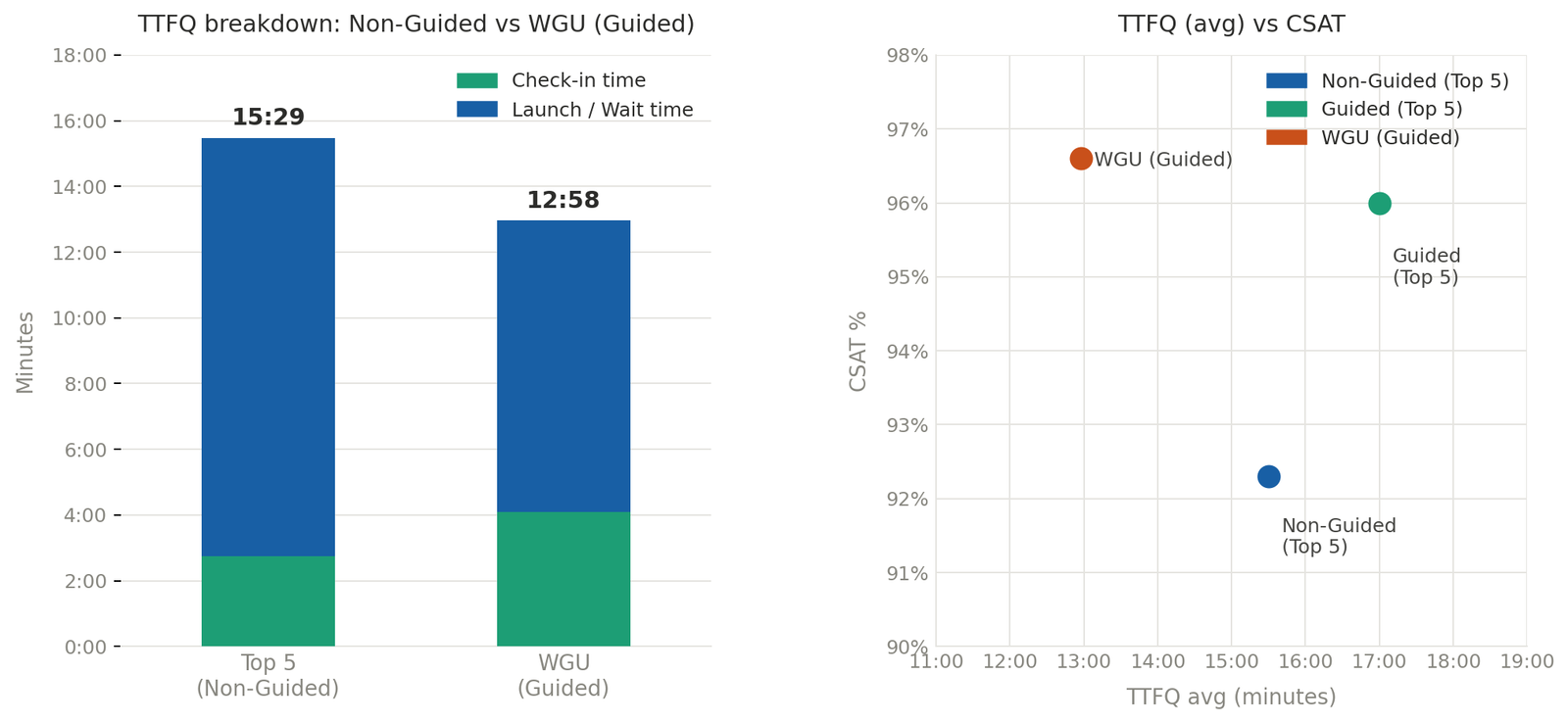
Left: the mechanism. WGU’s guided flow spends +1:20 more in check-in and buys back nearly four minutes of serialized launch — 2:31 faster end to end.
Right: the honest part. Guided moves CSAT reliably (96.0–96.6% vs 92.3%) but not TTFQ. The guided Top 5 average is ~17:00 — slower than non-guided. Only WGU lands at 12:58.
That inconsistency is the argument for the project. Guided works when implemented well and drags when it isn’t, because every line had its own version. Standardizing is how every account gets WGU’s result instead of the average one.
What the market was doing
| Platform | Launch model | Typical launch time | Secure browser | Human involvement at setup | Security depth | Test-taker sentiment | Primary market |
|---|---|---|---|---|---|---|---|
| Meazure Learning | Guided, human-led | 8–12 min | Dedicated (Guardian) | Highproctor verifies identity, environment and applications | HighOS-level lockdown, 400+ app scan, continuous enforcement, VM detection | Mixedhuman touch valued; delays criticised | Certification & higher ed |
| Pearson VUE | Self-service → proctor queue | 15–30 min | Dedicated (OnVUE) | Mediumproctor reviews submissions from a queue | HighAI + human monitoring, face-matching, multiple accreditations | Largely negativestrictness, terminations, support | High-stakes certification (IT, professional) |
| Honorlock | AI-first, automated | ~1–3 min | Chrome extension | None at setupAI triggers human pop-in only during the exam | Mediumextension-level lockdown, AI detection, secondary device detection | Very negativeprivacy backlash, bias reports | Higher education |
| PSI | Self-service → proctor review | 10–15 min | Dedicated (PSI Secure) | Mediumproctor reviews environment scan | Highbiometric checks, deepfake detection, gen-AI response detection | Largely negativedisconnections, support | Certification & licensure |
| Proctorio | Fully automated | ~2–5 min | Chrome extension | Nonefully AI / automated | MediumChrome-level lockdown, post-hoc review only | Polarizedspeed loved, surveillance feared | Higher education |
Scroll horizontally to see every column.
This reframed the project. The fast platforms are fast because they removed the human. Honorlock (~1–3 min) and Proctorio (~2–5 min) market on speed and have no proctor at setup at all. We were benchmarked against a number that isn’t comparable — against the platforms that do keep a human, Pearson VUE (15–30) and PSI (10–15), our 8–12 was already the fastest in the category.
And removing the human is what creates the sentiment problem:
- Pearson VUE — 2,500+ mostly negative reviews. “My exam was revoked after a brief moment of movement. No explanation, told to pay again.”
- Honorlock — a 6,300-signature petition at UT Dallas. “Having to scan your workspace, which is often a bedroom, makes students uncomfortable.”
- Proctorio — “I was stressing out the whole time, because I felt as if any movement would be a red flag.”
- PSI — “I experienced 5 disconnections requiring rescanning my environment nearly every 22 minutes.”
No platform in the category enjoys strong favourability, which cuts both ways: it’s why speed claims land, and why any improvement builds goodwill out of proportion to its size.
So the brief sharpened: get faster without removing the human — because the human is both the differentiator and the cost.
Solution
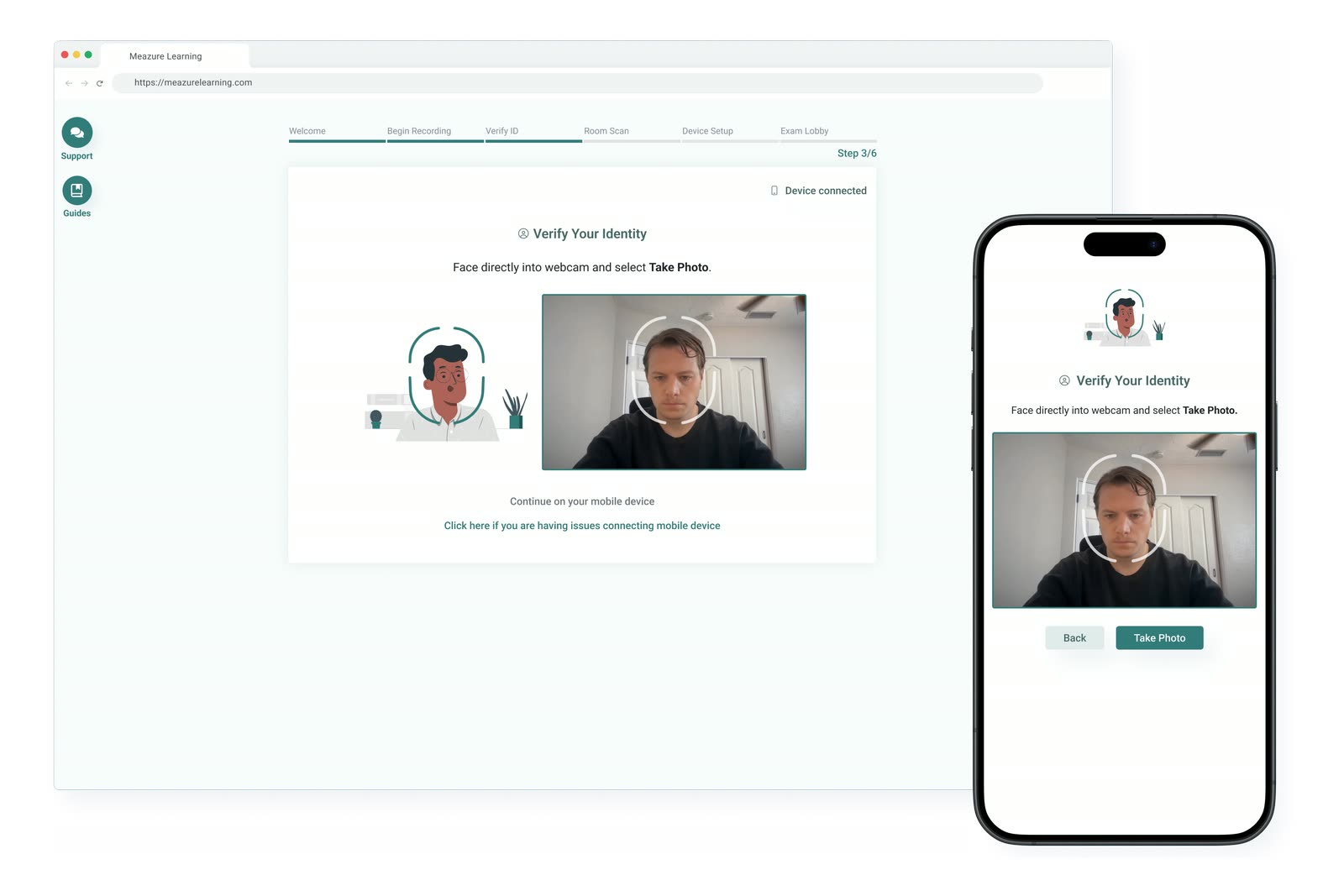
QR scan → verify ID → room scan → device setup → exam lobby.
Open the Guided Launch file in Figma
| Lobby check-in | Verified Check-In | |
|---|---|---|
| Capture device | Desktop webcam | Mobile default, desktop configurable |
| ID check | Held to webcam, judged live | Captured, retained, OCR-validated (m2) |
| Room check | Live pan, proctor directing | 4-point scan, stills + video |
| Retained evidence | None — ephemeral | Attached to the session record |
| Launch time | The bottleneck | Greatly reduced |
This was a system, not a screen. Review+ gains the most — no Guided Launch existed there, so it goes straight from full lobby check-in to guided capture, with retained evidence and shorter launches for the first time. Record+ gains a pre-exam step it never had, reviewed by customers after the session. Live+ sees waits reduced but not eliminated, and the guidance says so rather than rounding up.
Decisions with real tradeoffs
Accept a longer check-in. +1:30, taken deliberately — it’s the test taker’s own parallel time, and it buys serialized proctor minutes. The honest cost: anyone who would have hit an empty queue is now slower. There was no universal speed win.
Video, not just stills. Stills invite the question a security officer will eventually ask — were these taken now, of this room, by this person? Continuous video answers it, and lobby check-in never produced that artifact at all. Which makes the counterintuitive claim true: the automated process is more secure than the live one.
Naming as design work. Retired “Guided Launch”: it implied test takers launch themselves when a proctor still reviews, greets and launches, and customers read it as less secure. Kept “Lobby check-in” as a live term so those customers could be told they were early, not deprecated. Ruled out “manual,” “human” and “proctor-led” check-in — each implies the new process is less of those things, and it isn’t. Ruled out “mobile check-in” because it names a configuration, not a product.
Impact
Rollout is in flight. Milestone 1 shipped, milestone 2 in build. These are the numbers that exist, not a tidy retrospective.
- ~7:30 TTFQ in testing — roughly half the 15:29 non-guided flow it replaces, and ~5:30 faster than the best guided implementation we had
- 12:58 vs 15:29 in production — the comparison that justified building it
- CSAT 96.6% vs 92.3% on that guided cohort
- 8–12 minute launch against 15–30 at Pearson VUE and 10–15 at PSI — the only platform in that range still running a live proctor
Beyond the clock: better captures end redundant verification, proctors get what they need upfront for faster and more consistent launch decisions, and mobile capture is a differentiator no competitor in the set offers.
Next — AI-guided prechecks
Milestone 2 validates the capture while the test taker is still in the step, rather than letting unusable evidence reach a proctor. Phase 1 covers capture quality (brightness, blur, glare, face positioning, ID framing, room-scan clarity) and OCR to extract legal first name, last name and expiry from the ID.
The OCR is aimed squarely at the proctor’s job. Today, reading an ID is manual work — the PRD lists “inconsistent or hard-to-read names on an ID” as a case where the “proctor spends time manually reading/comparing registration data.” Extracting those fields and showing them next to the registered test-taker information turns a squint-and-compare into a glance. The evidence panel puts the validation outcome, its reason, the image itself, the extracted fields and the registration data in one place, with the proctor still making the call and able to override anything.
Face matching — selfie against ID, live capture against selfie, and continuity across steps — is the stretch goal for Q4 and otherwise Phase 2, alongside liveness detection for printed photos and screen replays. Worth being precise about that order: Phase 1 makes the ID readable, Phase 2 makes the face checkable. Getting capture quality right first is what makes any later matching worth trusting, since a face-match model is only as good as the image handed to it.
The PRD states the problem in almost exactly the terms the research found:
Test-takers can currently complete pre-checks even when the captured image, video, or identity information is not sufficient for reliable proctor review. As a result, these pre-check captures are often ignored and not used for validation, and proctors instead perform the verification again by asking the test-taker to present their ID and complete the room scan live.
And it holds the line on what the AI is for, which is the part I care most about:
The objective is not to remove the proctor from the decision-making process. The objective is to improve the quality of information presented to the proctor, reduce unnecessary manual rechecks, standardize the launch process, and help test-takers resolve common issues before reaching a proctor.
That constraint runs all the way down. Uncertain OCR routes to Review, not Block — the AI never independently denies exam access. Rollout goes Advisory before Assisted, so the model runs silently against real proctor decisions before it can change anyone’s flow. And every outcome has to be explainable:
Every Retry or Review needs a reason. “Validation failed” is not sufficient.
Which is a design requirement dressed as an engineering one. It’s what makes the difference between “your ID was rejected” and “Your ID is difficult to read because of glare. Tilt the ID slightly and try again.”
Blue sky: the code prototype
The vision didn’t stay in Figma. I built it as a working code prototype on the new design system — real components, real states, clickable end to end. A prototype you can drive answers questions comps can’t: how the flow feels at speed, where a step stalls, and whether the capture feedback actually lands. It also meant the design system got exercised against a real flow before anyone committed to it.
Walkthrough of the code prototype — 1:19, no audio.
Reflection
The +1:30 is still unresolved for the low-queue case — anyone who’d have walked into an empty lobby is now slower, and averaging doesn’t make that untrue for them.
The retired tutorial videos are the lesson I’d carry: the flow could change faster than the assets explaining it, because the team that made them was gone.
And the question the competitive work left me with: “shift left” has a limit. Every step moved to the test taker is a step they take alone. Honorlock and Proctorio are the far end of that, and their reviews are the argument against it.