Proctoring · Interaction Design
Second Camera
A second-camera setup that replaces the momentary room pan with a continuous 270° view of the workspace, using the test taker's own phone — which takes the most capable cheating device in the room out of play.
The room pan looks like security. A test taker sweeps their webcam around the room for a few seconds, a proctor watches, and the session begins. It is a photograph of a moment, presented as a guarantee about the next three hours.
Problem
A few seconds of 360° video proves very little. It proves the room looked a certain way at the instant it was scanned — not that it stayed that way, not that nothing was within reach, and not that nobody walked in afterwards. Once the pan ends, the space around the test taker goes unobserved for the rest of the exam. The primary webcam looks at a face; it has its back to everything else.
And the pan ignores the most capable device in the room. A phone is a browser, a camera, a calculator and a second person on a call. The conventional answer is to ask the test taker to set it aside, which is an instruction, not a control — you have asked the one object that defeats the exam to please sit quietly off-camera.
Solution
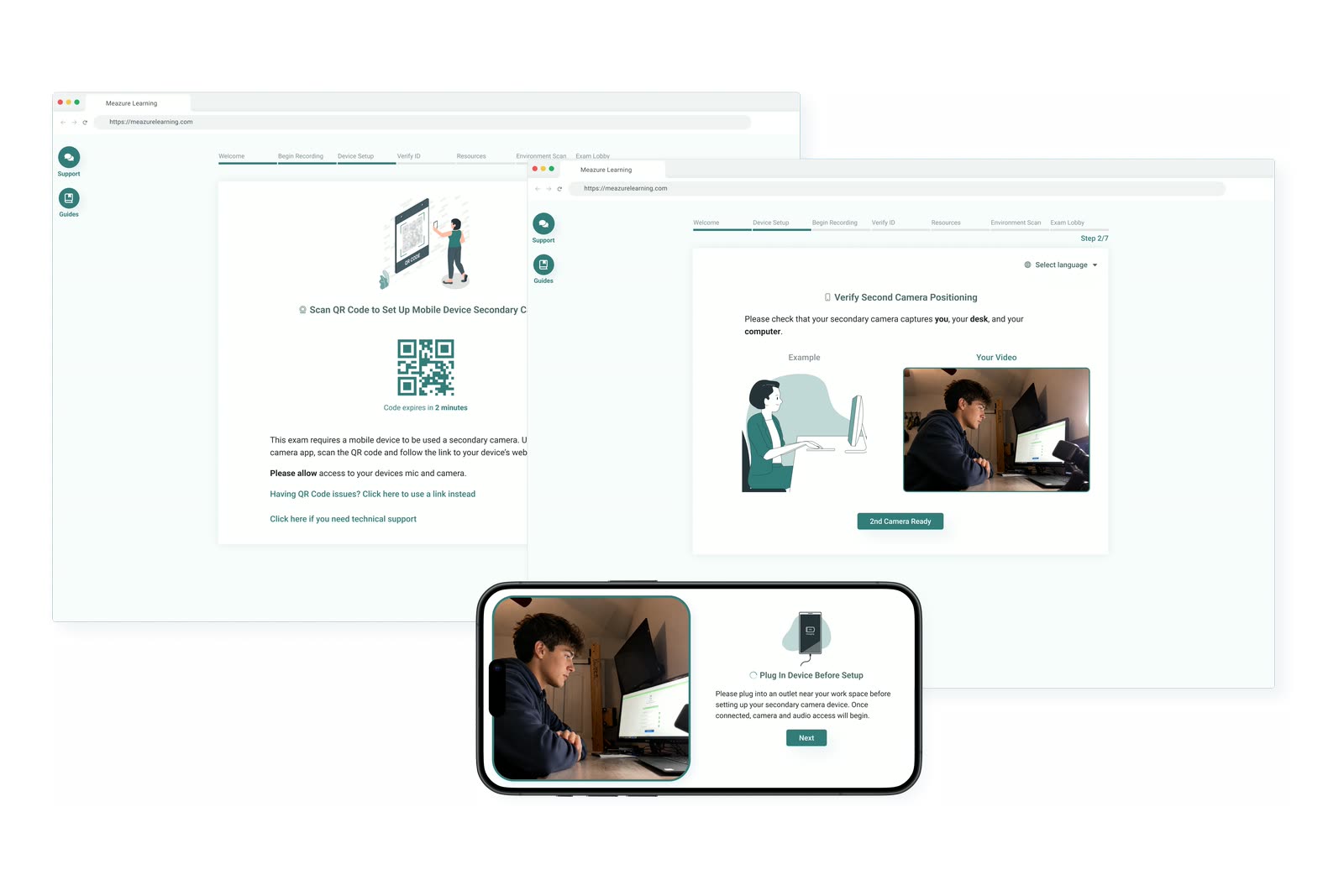
The two workflows side by side — the room pan being replaced, and the second-camera setup replacing it. Open in Figma
Replace the snapshot with a live feed. The second camera streams a continuous 270° view of the workspace — hands, keyboard, desk surface and the space either side — for the duration of the exam, not for a few seconds at the start. Coverage stops being a moment a proctor has to remember and becomes a view they can return to at any point, including after the fact.
Make the phone the camera. The device is the test taker’s own, and enrolling it as the second camera occupies it: it is running the stream, in view of the proctor, propped where both the proctor and the test taker can see it. The object that was the biggest hole in the room is now the thing watching the room. That converts an instruction into a constraint, which is the only version of a rule that holds under pressure.
And it shortens the launch. A room pan is something a proctor has to sit through and judge before the exam can start — serialized time, one session at a time. A live feed needs no up-front review; it is simply there, and a proctor can look whenever there is a reason to. So removing the pan takes that review out of the launch entirely: launch time comes down, and overall time to first question comes down with it. That is the same trade Verified Check-In makes — move work out of the window where a proctor is watching one person at a time.
The setup is the design problem
None of that pays off if the camera ends up pointed at a wall. A phone has to be enrolled, oriented, powered and placed — none of which it is set up to do — and every one of those is a chance to fail before the exam starts, when the test taker has the least patience for it.
On the phone: scan the QR code → grant camera access → confirm device settings → rotate to landscape → plug in → position the camera. On the desktop: scan the QR code → verify the positioning → continue to the exam lobby.
A few decisions carry most of the weight:
The QR handoff keeps the phone out of the credential path. No typing a URL on a phone keyboard, no second login, no password entered on a device about to be pointed at the desk. Scanning is the entire enrolment.
“Plug in your device” is a step, not a footnote. A dead phone mid-exam doesn’t just lose the camera — it hands the device back. Making it an explicit gate, with its own screen, is the cheapest insurance available.
Rotate to landscape is what makes 270° possible. A portrait phone shows a slice of the room; landscape is the difference between a camera pointed at a wall and one that covers the workspace.
Positioning is verified, not assumed. The desktop side shows the live feed against a reference image and asks for confirmation before the test taker reaches the lobby — so a bad angle fails while it is still cheap to fix, rather than being discovered by a proctor at launch or by a reviewer afterwards.